
Varicocele in Men: Symptoms, Causes and Treatment Options
Varicocele in Men: Symptoms, Causes and Treatment Options
Varicocele is one of the more frequently identified conditions during a male fertility assessment. It develops when veins within the scrotum become enlarged because blood does not drain efficiently from the testicles. For some men, the condition is simply an incidental finding. For others, it may contribute to a dull scrotal ache, a feeling of heaviness, changes in testicular size or abnormal semen results.
A varicocele does not automatically mean that a man is infertile. Many men with this condition can father children without treatment, while others may experience changes in sperm production or function. The important question is not only whether a varicocele is present, but whether it is causing symptoms, affecting testicular development or contributing to a couple’s difficulty conceiving.
Varicoceles affect approximately 15% of the general male population, according to the European Association of Urology (EAU). The condition is more frequently identified in men attending fertility clinics: the EAU reports it in approximately 35–40% of men presenting with infertility. These figures describe how often varicoceles are found in different groups; they do not mean that every affected man will develop infertility. EAU Male Infertility Guidelines.
This guide explains what a varicocele is, why it develops, which symptoms may occur, how doctors diagnose it and when treatment may be appropriate. It also discusses the differences between varicocele surgery and embolization, their potential benefits and limitations, and the questions men should discuss with a urologist.
What Is a Varicocele?
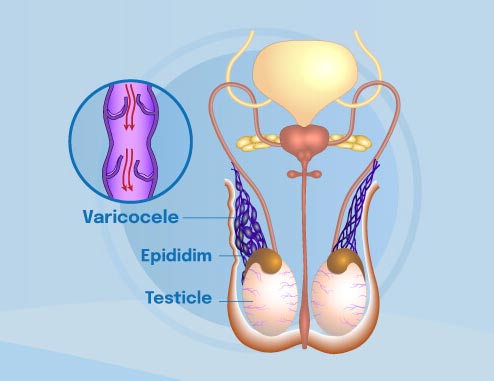
A varicocele is an enlargement of the veins that form a network around the spermatic cord and drain blood from the testicles. This network is known as the pampiniform plexus. It helps regulate testicular temperature, which is important because normal sperm production requires the testicles to remain slightly cooler than the body’s core temperature.
Veins contain valves that help blood move in the correct direction. When these valves do not function properly, blood can flow backwards or collect in the veins. The resulting increase in pressure can cause the veins to become enlarged and twisted. This is similar in principle to varicose veins that develop in the legs.
Varicoceles are usually found on the left side of the scrotum. This pattern is related to differences in the anatomy and drainage of the testicular veins. The left testicular vein drains into the left renal vein, while the right testicular vein usually drains directly into the inferior vena cava. These anatomical differences can make increased venous pressure more likely on the left.
A varicocele may be visible or palpable during a physical examination, particularly when a man is standing. Larger varicoceles are sometimes described as feeling like a soft “bag of worms” above the testicle. Smaller ones may only be detected when a doctor asks the patient to stand and strain.
The condition is not the same as a testicular tumour, hydrocele or infection. However, several scrotal conditions can cause swelling or discomfort, so a new lump or change in testicular size should be assessed rather than diagnosed through self-examination alone.
How Common Is Varicocele in Men?
Varicocele is relatively common and often develops around puberty, when blood flow to the reproductive organs increases as the body matures. It may remain unnoticed for years because many affected men do not experience pain or other obvious symptoms.
The EAU’s 2025 male infertility guidance reports the following approximate prevalence figures:
| Population | Reported prevalence |
| General male population | 15% |
| Men with abnormal semen analysis | 25% |
| Men presenting with infertility | 35–40% |
These figures show why varicocele is an important consideration during male fertility investigations. They should not be interpreted as proof that the varicocele caused infertility in every person included in those groups. Infertility can have several male and female factors, and a complete assessment is necessary before deciding on treatment.
The condition is also more frequently associated with the left testicle. Bilateral varicoceles can occur, while an isolated right-sided varicocele is less common. A newly identified, isolated right-sided varicocele may require further medical assessment to investigate possible abdominal or retroperitoneal causes.
Causes of Varicocele in Men
The precise reason why one man develops a varicocele and another does not is not always clear. In many cases, the condition is associated with the structure of the testicular veins and the way blood drains from the scrotum.
1. Faulty or Weak Vein Valves
Healthy veins contain valves that help prevent blood from flowing backwards. If these valves are weak, damaged or do not close properly, blood may collect in the veins around the testicle. Over time, this can increase venous pressure and enlarge the vessels.
This is one of the main mechanisms associated with varicocele development. It also helps explain why the condition can become more noticeable when a person is standing, exercising or straining.
2. Differences in Vein Anatomy
The left testicular vein has a different drainage pattern from the right. It usually joins the left renal vein, whereas the right testicular vein normally drains directly into the inferior vena cava. Differences in the route and pressure of venous drainage are believed to contribute to the higher frequency of left-sided varicoceles.
This anatomical explanation is important because it helps clarify why a varicocele is not necessarily caused by an activity, injury or lifestyle choice.
3. Development During Puberty
Varicoceles commonly become apparent during adolescence. As the body develops, blood flow to the reproductive organs increases. A pre-existing weakness in venous valves or differences in vein anatomy may become more noticeable during this period.
Most adolescents with a varicocele do not automatically need surgery. Doctors may monitor testicular growth and development over time, particularly if one testicle appears smaller than the other.
4. Increased Pressure Within the Veins
Activities that temporarily increase abdominal pressure, such as heavy lifting or straining, may make an existing varicocele more noticeable. However, this does not establish that lifting weights or performing physical exercise directly causes the condition.
Men should not assume that they developed a varicocele because of a particular workout, occupation or sexual activity. The underlying issue is generally related to venous drainage and valve function.
Symptoms of Varicocele in Men
Many men with varicocele have no symptoms. The condition may be discovered during a routine examination, an assessment for testicular discomfort or an investigation into difficulty conceiving.
When symptoms occur, they can vary according to the size of the enlarged veins and whether the condition is affecting nearby tissues or testicular function.
1. Dull Pain or Aching in the Scrotum
One of the recognised symptoms is a dull, dragging or aching sensation in the affected side of the scrotum. The discomfort may become more noticeable after prolonged standing, physical activity or the end of a busy day.
Unlike the sudden, severe pain associated with certain emergencies, varicocele-related discomfort is more commonly gradual. It may improve when the person lies down because the position can reduce pressure within the affected veins.
Persistent scrotal pain should still be assessed. Not all testicular discomfort is caused by varicocele, and a doctor may need to investigate other conditions before attributing pain to enlarged veins.
2. Swollen or Enlarged Veins Above the Testicle
Some men notice enlarged veins above or around the testicle. A larger varicocele may be visible through the scrotal skin or feel like a cluster of soft, twisted veins.
The appearance can become more noticeable when standing and may reduce when lying down. However, the absence of visible swelling does not rule out a smaller varicocele.
3. A Feeling of Heaviness in the Scrotum
A man may describe a dragging sensation, pressure or heaviness in the scrotum. This can be particularly noticeable after standing for a long period or undertaking strenuous activity.
The symptom may be mild and intermittent, but persistent discomfort can affect exercise, work and everyday activities. A medical assessment can help determine whether the varicocele is responsible.
4. Difference in Testicular Size
In some cases, a varicocele is associated with reduced growth or shrinkage of the affected testicle. This is especially relevant in adolescents, whose testicular development can be monitored over time.
A difference in testicular size does not prove that a varicocele is responsible. The doctor will consider the examination findings, the patient’s age and, when appropriate, ultrasound measurements.
5. Fertility Problems
Varicocele is associated with male infertility in some men. Possible changes include reduced sperm concentration, impaired sperm movement and changes in sperm shape or function.
However, a varicocele does not mean that conception is impossible. Some men with a clinically detectable varicocele have normal semen results, while others may have additional factors contributing to infertility. A semen analysis and evaluation of both partners are important when a couple has difficulty conceiving.
6. No Noticeable Symptoms
The absence of pain or swelling is common. A man may only learn that he has a varicocele when a doctor examines the scrotum or investigates fertility concerns.
This is why symptom-based self-assessment is not enough to determine whether a varicocele is present or whether it requires treatment.
How Can Varicocele Affect Male Fertility?
The relationship between varicocele and fertility is one of the most important reasons for evaluating the condition. Sperm production takes place inside the testicles and depends on a suitable temperature and a healthy testicular environment.
The pampiniform plexus normally helps cool blood entering the testicles. When blood collects in enlarged veins, the local temperature may rise. Researchers also investigate other possible mechanisms, including altered blood flow, reduced oxygen availability, oxidative stress and changes in the testicular environment.
These mechanisms may affect sperm production or function in susceptible men. Possible findings on semen analysis include:
- Reduced sperm concentration.
- Lower sperm motility, meaning a reduced ability of sperm to move effectively.
- A higher proportion of sperm with abnormal morphology, or shape.
- Changes in sperm DNA integrity in some men.
The impact is not identical in every patient. A man may have a varicocele without measurable fertility problems, while another may have abnormal semen parameters. The grade of the varicocele, testicular size, age and other reproductive health factors may all be relevant.
The EAU reports that varicocele is present in approximately 25% of men with abnormal semen analysis and 35–40% of men presenting with infertility. These are association figures, not proof of direct causation in an individual patient. The same guideline states that repair may improve pregnancy rates and sperm concentration in appropriately selected infertile men with abnormal semen results, while improvements in sperm motility and normal morphology are less certain.
For this reason, fertility treatment decisions should be based on a complete assessment rather than the ultrasound finding alone.
Grades of Varicocele
Doctors commonly describe a varicocele according to its size and whether it can be felt or seen during examination. The EAU clinical classification includes three palpable grades and a separate category for varicoceles detected only through imaging.
Grade 1 Varicocele
A Grade 1 varicocele is small and can generally be felt only when the patient performs a Valsalva manoeuvre. This involves taking a breath and straining as if trying to pass a bowel movement. It may not be noticeable during an ordinary examination at rest.
Grade 2 Varicocele
A Grade 2 varicocele can be felt when the patient is standing, even without straining. It may not be clearly visible through the skin.
Grade 3 Varicocele
A Grade 3 varicocele is larger and can usually be seen and felt during examination. The enlarged veins may create the characteristic soft, twisted appearance sometimes described as a bag of worms.
Subclinical Varicocele
A subclinical varicocele cannot be felt or seen during a physical examination but may be identified on ultrasound. This distinction matters because international guidelines do not recommend routine varicocele repair simply because a non-palpable varicocele appears on imaging.
The grade alone does not determine whether surgery is necessary. Symptoms, semen analysis, testicular development and reproductive goals must also be considered.
How Is Varicocele Diagnosed?
A urologist usually begins with a medical history and physical examination. The doctor may ask about pain, swelling, how long symptoms have been present, previous fertility investigations and any changes in testicular size.
1. Physical Examination
The examination is commonly performed while the patient is standing and may be repeated while lying down. The doctor checks for enlarged veins, differences in testicular size and other possible causes of scrotal swelling.
A Valsalva manoeuvre may be used to make a small varicocele easier to detect. This examination helps the clinician determine whether the varicocele is palpable and how it should be classified.
2. Scrotal Doppler Ultrasound
A scrotal ultrasound uses sound waves to produce images of the testicles and surrounding structures. Doppler ultrasound also assesses blood movement through the veins.
It may be requested when the physical examination is inconclusive, when another scrotal condition needs to be excluded or when a doctor needs to investigate a suspected recurrent varicocele after treatment.
The EAU guideline notes that a maximum vein diameter greater than 3 mm when upright and performing a Valsalva manoeuvre, together with reflux lasting more than two seconds, correlates with a clinically significant varicocele. These are clinical ultrasound criteria; they should be interpreted by a qualified clinician rather than used as a home diagnostic test.
3. Semen Analysis
For men concerned about fertility, semen analysis is a key part of the assessment. A laboratory examines a semen sample for parameters such as sperm concentration, movement and morphology.
An abnormal result does not automatically establish that varicocele is the cause. Semen results can vary, and the clinician may recommend repeat testing and further evaluation depending on the circumstances.
4. Hormone Testing
Blood tests may be considered when symptoms, examination findings or fertility results suggest a hormonal problem. Depending on the clinical situation, testing may include testosterone and hormones involved in regulating testicular function, such as follicle-stimulating hormone (FSH) and luteinising hormone (LH).
Hormone tests are not required for every man with a varicocele. The doctor selects investigations according to the patient’s symptoms and medical history.
5. Further Investigation for Selected Patients
An isolated right-sided varicocele, particularly if it is new or has unusual clinical features, may lead a doctor to investigate the abdomen and retroperitoneal area. This is not because every right-sided varicocele indicates a serious disease, but because less common causes may need to be excluded.
Treatment Options for Varicocele in Men
Not every varicocele needs treatment. If the condition is small, causes no discomfort, is not associated with testicular growth concerns and is not linked to relevant fertility problems, a doctor may recommend observation.
Treatment is generally considered when there is persistent pain consistent with varicocele, testicular growth impairment in an adolescent, or a specific fertility indication. The most suitable approach depends on the examination findings, semen results, reproductive plans, general health and the expertise available.
1. Observation and Regular Monitoring
Observation may be appropriate for men who have no significant symptoms or evidence of testicular damage. Monitoring can include clinical examinations and, when indicated, repeat assessment of testicular size or semen parameters.
For adolescents, follow-up is particularly important if one testicle appears smaller. The EAU recommends offering surgery when a persistent testicular size difference greater than 2 mL or 20% is confirmed on two visits six months apart. This recommendation is intended to avoid unnecessary treatment based on a single measurement.
Observation does not mean ignoring the condition. It means that the potential benefits of an intervention do not currently outweigh the reasons for monitoring.
2. Lifestyle Measures and Symptom Management
Lifestyle measures cannot repair faulty vein valves or remove an established varicocele. However, some practical steps may help men manage mild discomfort while they are being assessed or monitored.
A clinician may suggest supportive underwear, reducing activities that consistently aggravate discomfort and using suitable pain relief when medically appropriate. Taking breaks from prolonged standing may also help some patients.
These measures are intended for symptom management, not as a cure. Men should not rely on supplements, massage, herbal remedies or unverified exercises to reverse enlarged testicular veins. There is no established evidence that these approaches correct the underlying venous problem.
3. Varicocelectomy: Surgical Repair
Varicocelectomy is a procedure in which the enlarged veins responsible for the varicocele are tied off or sealed so that blood can be redirected through healthier veins.
A common approach is microsurgical varicocelectomy. The surgeon uses magnification to identify the veins that need treatment while preserving important structures, including arteries and lymphatic vessels.
Microsurgical repair is often performed through a small incision in the groin or below the groin. The exact technique and anaesthesia plan depend on the surgeon and the patient’s circumstances.
Potential benefits include reduced varicocele-related pain, improvement in testicular growth in selected adolescents and improved semen parameters in appropriately selected infertile men. However, surgery cannot guarantee pregnancy or restore fertility in every patient.
Possible complications include recurrence or persistence of the varicocele, infection, bleeding, bruising, hydrocele formation and, rarely, injury to the testicular artery. Patients should ask the surgeon about the expected benefits, individual risks, recovery instructions and follow-up plan.
4. Varicocele Embolization
Varicocele embolization is a minimally invasive procedure performed by an interventional radiologist. Instead of surgically tying off the affected veins, the specialist accesses a vein through a small catheter and guides it towards the veins responsible for the varicocele.
The abnormal veins are then blocked using coils or other embolic materials. This redirects blood away from the enlarged vessels.
Embolization generally avoids a surgical incision in the groin and may be performed using local anaesthesia with or without sedation, depending on the centre and patient. Recovery may be shorter for some patients, but the procedure is not suitable for everyone.
Potential risks include bleeding or bruising at the access site, infection, allergic reaction to contrast material, coil migration and recurrence. The procedure may also be technically unsuccessful if the relevant veins cannot be accessed or treated as planned.
The choice between embolization and surgery should be discussed with both the treating urologist and, where appropriate, an interventional radiologist. Availability and outcomes can vary by centre and individual anatomy.
5. Treatment for Varicocele-Related Infertility
For men trying to conceive, treatment decisions should consider whether the varicocele is palpable, whether semen parameters are abnormal and whether other explanations for infertility have been investigated.
The American Urological Association and American Society for Reproductive Medicine (AUA/ASRM) guideline recommends considering surgical varicocele repair in men attempting conception who have palpable varicoceles, infertility and abnormal semen parameters, with an exception noted for azoospermic men. It also advises against recommending varicocelectomy for varicoceles that are detected only through imaging and cannot be felt on examination.
The EAU similarly recommends treatment for appropriately selected infertile men with a clinical varicocele, abnormal semen parameters and otherwise unexplained male-factor infertility, taking the couple’s reproductive circumstances into account.
Men with non-obstructive azoospermia should receive particularly careful counselling. The AUA/ASRM guideline states that definitive evidence supporting varicocele repair before assisted reproductive treatment is lacking in this group.
Does Varicocele Treatment Improve Fertility?
Varicocele repair can improve semen parameters in some men, but the result depends on patient selection and individual reproductive factors. It is important to separate improvement in a laboratory result from the ultimate outcome of achieving a pregnancy or live birth.
The 2024 AUA/ASRM guideline discusses a meta-analysis that estimated pregnancy rates of approximately 17% without treatment and higher rates in groups undergoing different varicocele repair techniques. For example, the estimated rate for subinguinal microsurgical varicocelectomy was 42%, with a reported 95% confidence interval of 26–61%.
These figures should be interpreted cautiously. The guideline notes that the underlying evidence included non-randomised studies and selective outcome reporting. The estimates are not a personal prediction, a guarantee of success or proof that one operation will produce the same result in every setting.
The EAU also reports that varicocele repair may improve pregnancy rates and sperm concentration in adult infertile men with abnormal semen analysis. It notes that the evidence for improvements in sperm motility and normal morphology is less clear.
After treatment, the specialist may recommend repeat semen analysis to assess whether sperm parameters have changed. Couples should also discuss the time available for conception, the female partner’s age and fertility assessment, and whether assisted reproductive treatment may be appropriate.
Recovery After Varicocele Surgery or Embolization
Recovery depends on the procedure, the patient’s health and the treating centre’s instructions. Men should follow their own discharge guidance rather than rely on a fixed recovery timetable from an online article.
After surgical repair, some temporary bruising, swelling or tenderness may occur. The surgeon will explain how to care for the incision, when to resume work and exercise, and when sexual activity can safely restart. Strenuous activity and heavy lifting may need to be restricted for a period.
After embolization, patients may experience mild discomfort or bruising around the catheter entry site. Because the procedure uses a small access point rather than a groin incision, some patients can return to routine activities sooner, although recovery varies.
Follow-up is important after either procedure. The clinician may assess symptoms, examine the scrotum and request ultrasound or semen analysis when appropriate. A varicocele can persist or recur, so ongoing symptoms should be reported rather than assumed to be a normal part of healing.
Possible Complications of Untreated Varicocele
Many varicoceles remain stable and do not cause significant health problems. Nevertheless, selected cases may be associated with persistent scrotal discomfort, reduced testicular growth or abnormal semen parameters.
In adolescents, a persistent difference in testicular size may indicate that development is being affected. In adults, a varicocele may be one factor contributing to male infertility, particularly when semen analysis is abnormal.
It is not accurate to say that every untreated varicocele will cause infertility, permanent testicular damage or low testosterone. The risk varies, and the available evidence does not support treating every varicocele simply to prevent a possible future problem.
The most appropriate course is an individual assessment that considers symptoms, age, testicular size, fertility goals and investigation results.
When Should a Man See a Doctor?
A man should arrange a medical assessment if he notices a new scrotal lump, enlarged veins, persistent aching, swelling or a change in testicular size. A urologist can determine whether the finding is a varicocele or another condition that requires different management.
Seek urgent medical attention for sudden or severe testicular pain, particularly if it is accompanied by nausea, vomiting or abdominal pain. These symptoms may indicate testicular torsion, in which the spermatic cord twists and blood supply to the testicle can be compromised. Torsion is a medical emergency and should not be assumed to be a varicocele.
The NHS advises immediate emergency assessment for sudden, severe testicular pain and for pain associated with feeling sick or being sick. Do not delay urgent assessment while waiting to see whether the pain settles. NHS: Testicle Pain.
Conclusion
Varicocele is a common enlargement of the veins around the testicles. Although it often causes no symptoms, it can be associated with scrotal discomfort, testicular growth changes and abnormal semen parameters in some men. Its presence alone does not establish infertility or mean that surgery is necessary.
A careful diagnosis usually involves a physical examination and, when appropriate, Doppler ultrasound, semen analysis and selected hormone tests. Observation may be suitable for men without significant symptoms or fertility concerns. For appropriately selected patients, microsurgical varicocelectomy or varicocele embolization may be considered.
The most important step is to base treatment on clinical findings and reproductive goals rather than the varicocele grade or an ultrasound report alone. Men who notice a new lump, persistent pain or changes in testicular size should arrange a medical assessment. Sudden severe testicular pain requires emergency evaluation because it may indicate testicular torsion rather than varicocele.
This article is for general educational purposes and does not replace an examination, diagnosis or treatment plan from a qualified healthcare professional.
Frequently Asked Questions About Varicocele in Men
1. Can varicocele cause infertility in men?
Varicocele can contribute to male infertility in some men by affecting the testicular environment and sperm production or function. However, many men with varicocele remain fertile. A semen analysis and a full fertility assessment are needed to understand whether the condition may be contributing to difficulty conceiving.
2. Is varicocele a dangerous condition?
Most varicoceles are not medical emergencies and do not cause serious symptoms. However, a varicocele may be associated with persistent pain, testicular growth problems or abnormal semen parameters. A new scrotal lump or change in testicular size should be examined by a healthcare professional.
3. Can varicocele go away without surgery?
A varicocele does not generally disappear through home remedies or lifestyle changes. If it causes no significant symptoms or reproductive concerns, treatment may not be necessary. A doctor may recommend monitoring rather than surgery.
4. Does varicocele always occur on the left side?
No. Varicoceles are more common on the left because of differences in the anatomy of the testicular veins. They can also occur on both sides or, less commonly, only on the right. An isolated right-sided varicocele may require further investigation.
5. Can exercise make a varicocele worse?
Some men notice more discomfort after strenuous exercise or prolonged standing. This does not prove that exercise causes a varicocele or that all physical activity must stop. If a particular activity consistently causes pain, discuss it with a clinician and follow individual advice.
6. Does varicocele surgery guarantee pregnancy?
No. Varicocele repair may improve semen parameters and pregnancy chances in selected men, but it cannot guarantee conception. Fertility depends on several factors, including sperm health, the female partner’s reproductive health and the couple’s overall circumstances.
7. What is the difference between varicocele surgery and embolization?
Varicocele surgery involves tying off or sealing the enlarged veins through an operative approach. Embolization uses a catheter to block the affected veins from inside the blood vessels. Both aim to redirect blood away from the varicocele, but their suitability, risks and availability differ.
8. Is an ultrasound enough to diagnose a varicocele?
Ultrasound can identify enlarged veins and assess blood flow, but the diagnosis is usually based on clinical examination. Doppler ultrasound is particularly useful when the examination is uncertain or when another condition needs to be investigated. An ultrasound-only, non-palpable varicocele does not automatically require treatment.
9. Can varicocele affect testosterone levels?
Varicocele has been associated with testicular dysfunction and changes in testosterone in some men, but this does not mean every man with the condition has low testosterone. Testing may be appropriate when symptoms or clinical findings suggest a hormonal problem.
10. How long does recovery take after varicocele treatment?
Recovery varies according to whether the patient has surgery or embolization, the technique used and individual healing. The treating specialist should provide instructions about work, exercise, lifting and sexual activity. Follow-up is also important to assess symptoms and, when relevant, semen parameters.