
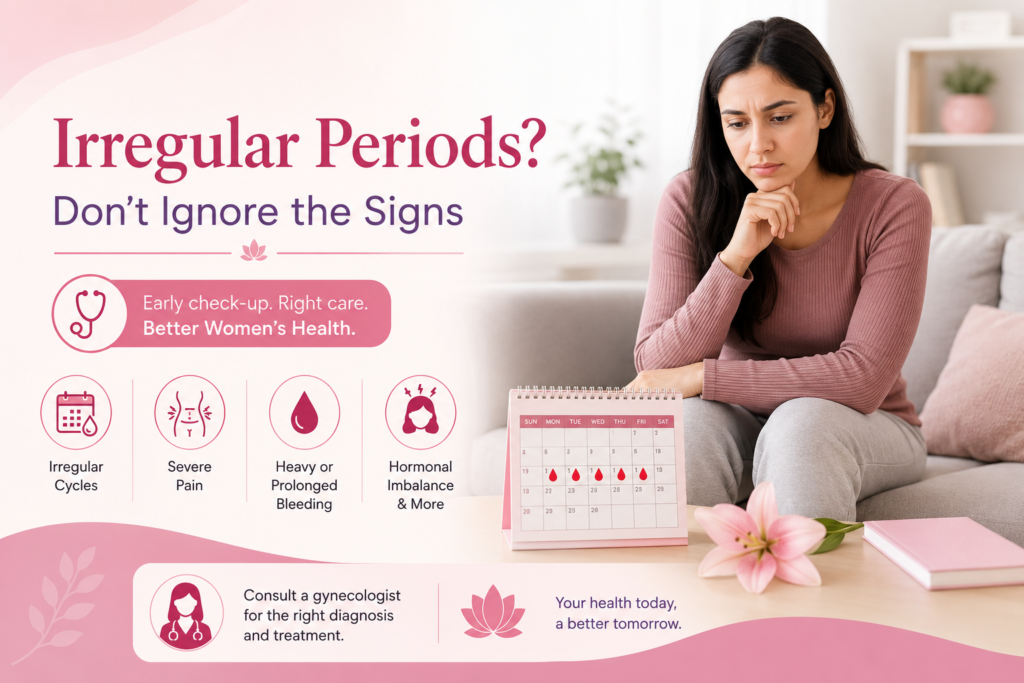
Irregular Periods: When Should You See a Doctor?
Irregular periods are common, but that does not always mean they should be ignored. A menstrual cycle can naturally vary because of age, puberty, pregnancy, breastfeeding, contraception, stress, changes in weight, exercise, or the transition toward menopause. However, a noticeable change from your usual cycle can sometimes be the first sign of a hormonal, reproductive, metabolic, or other health condition.
So, when should you see a doctor for irregular periods?
For many adults, menstrual cycles occurring less often than every 21 days or more often than every 35 days are considered outside the usual range. ACOG also considers a period absent for 3 months or more, when pregnancy and other normal explanations do not apply, something that should be medically evaluated.
The situation is slightly different for teenagers. During the first several years after menstruation begins, cycles can be longer and less predictable. Even so, ACOG notes that cycles occurring more frequently than every 21 days, less frequently than every 45 days, lasting longer than 7 days, or being separated by 90 days even once may warrant evaluation.
This guide explains what irregular periods can mean, when they require medical attention, which symptoms should not be dismissed, what causes doctors commonly investigate, what tests may be performed, and how tracking your menstrual cycle can help identify the underlying issue.
Medical note: This article provides general health information and is not a diagnosis. Persistent, severe, or unusual menstrual changes should be discussed with a qualified healthcare professional.
What Are Irregular Periods?
An irregular period is not simply a period that arrives a few days earlier or later than expected.
A menstrual cycle is counted from the first day of bleeding in one period to the first day of bleeding in the next. For most adults, a cycle between 21 and 35 days is generally considered typical, although individual variation exists. A period itself commonly lasts around 2 to 7 days.
Irregular menstruation can involve:
- Periods arriving less than 21 days apart
- Periods occurring more than 35 days apart
- Significant changes in cycle length from month to month
- Missing periods
- Bleeding lasting more than 7 days
- Bleeding between periods
- Bleeding after sex
- Very heavy menstrual bleeding
- A previously predictable cycle suddenly becoming unpredictable
For example, someone whose cycles normally occur every 28–30 days may reasonably notice a small variation from one month to another. But if those cycles suddenly become 20 days, then 42 days, then 60 days, the change deserves attention—particularly if it continues.
The NHS recommends speaking with a healthcare professional when periods become irregular or when a person’s normal pattern changes.
A useful distinction: irregular versus occasionally late
One late period does not automatically indicate a serious medical problem. Stress, illness, travel, changes in sleep, weight fluctuations, excessive exercise, pregnancy, and hormonal contraception can all affect the menstrual cycle.
The more important question is whether there is a persistent pattern or a significant change from your normal cycle.
That distinction is important for both patients and healthcare professionals because menstrual history can provide clues about ovulation, hormonal function, reproductive health, and certain metabolic conditions.
When Should You See a Doctor for Irregular Periods?
A doctor or gynecologist should evaluate irregular periods when they persist, become significantly different from your previous pattern, or occur alongside other concerning symptoms.
Your cycles are consistently shorter than 21 days or longer than 35 days
For adults, repeatedly having cycles outside the approximately 21–35-day range is a reason to discuss the pattern with a healthcare professional. ACOG identifies cycles shorter than 21 days or longer than 35 days as abnormal uterine bleeding patterns requiring attention.
This does not mean that every cycle outside this range indicates disease. Instead, it is a practical signal that further assessment may be appropriate.
The NHS similarly defines irregular periods as gaps of less than 21 days or more than 35 days between periods.
You have missed three periods
If you have previously menstruated and have gone 3 months without a period, medical evaluation is appropriate when pregnancy, breastfeeding, and menopause do not explain the absence.
ACOG describes secondary amenorrhea as the absence of periods for 3 months or more in someone who previously menstruated.
A missed period can occur for many reasons, including:
- Pregnancy
- Polycystic ovary syndrome
- Significant weight loss
- Low body weight
- Excessive exercise
- Stress
- Thyroid disorders
- Certain medications
- Hormonal contraception
- Primary ovarian insufficiency
- Some chronic illnesses
The first step is usually not to assume the worst. It is to identify why the menstrual cycle has changed.
Your periods were regular and suddenly became irregular
A change in an established menstrual pattern is often more informative than whether your cycle fits a textbook number.
If your periods have been predictable for years and suddenly become irregular, unusually heavy, very light, or absent, make an appointment with a healthcare professional.
ACOG specifically recommends evaluation when previously regular cycles become irregular.
This is particularly important when the change is accompanied by acne, excess facial hair, unexplained weight changes, fatigue, pelvic pain, abnormal discharge, headaches, vision changes, or difficulty becoming pregnant.
Your bleeding lasts longer than 7 days
A period lasting more than 7 days should be discussed with a healthcare professional, particularly if heavy bleeding is also present.
ACOG identifies bleeding lasting more than 7 days as one sign of heavy menstrual bleeding.
Long or heavy periods can contribute to iron deficiency and anemia, especially when the blood loss is significant or occurs repeatedly.
You need to change a pad or tampon every hour
Very heavy menstrual bleeding should not be dismissed as simply having a “bad period.”
ACOG identifies bleeding that soaks through one or more pads or tampons every hour for several hours in a row as a sign of heavy menstrual bleeding.
If heavy bleeding is accompanied by dizziness, fainting, weakness, shortness of breath, chest symptoms, or a racing heartbeat, urgent medical assessment may be necessary.
The exact level of urgency depends on the circumstances, but very heavy bleeding with symptoms of significant blood loss should be treated seriously.
When Are Irregular Periods an Emergency?
Most irregular periods do not require emergency treatment. However, certain combinations of symptoms can indicate a potentially urgent problem.
Seek urgent medical care if irregular bleeding is accompanied by severe or worsening pelvic or abdominal pain, fainting, significant dizziness, or very heavy bleeding.
One particularly important situation is a missed period followed by unusual vaginal bleeding and abdominal or pelvic pain. If pregnancy is possible, this combination needs prompt assessment because ectopic pregnancy can be dangerous. The NHS specifically advises urgent evaluation for unusual bleeding with abdominal or pelvic pain after a missed period.
Severe pelvic pain that is substantially worse than usual also warrants prompt medical attention, particularly if ordinary pain relief does not help.
Do not wait for your next scheduled appointment if bleeding is extremely heavy or you feel faint, weak, or seriously unwell.
Common Causes of Irregular Periods
Irregular periods have many possible causes. A doctor generally looks at the whole clinical picture rather than assuming that one particular condition is responsible.
Pregnancy
Pregnancy is one of the first possibilities to consider when a period is late or absent in someone who could become pregnant.
A missed period does not necessarily mean pregnancy, but pregnancy should generally be ruled out before investigating many other causes of amenorrhea.
If pregnancy is possible and your period is late, taking an appropriate pregnancy test is an important first step.
Polycystic Ovary Syndrome
Polycystic ovary syndrome, commonly called PCOS, is one of the most important causes of irregular or infrequent periods.
The World Health Organization estimates that PCOS affects approximately 10–13% of reproductive-aged women worldwide and notes that up to 70% of affected women may be undiagnosed.
PCOS can involve irregular or absent ovulation, elevated androgen levels, acne, increased facial or body hair, scalp hair thinning, and difficulty becoming pregnant.
Importantly, PCOS does not look identical in every person. Someone can have PCOS without every commonly discussed symptom, and the presence of ovarian cysts is not required for a diagnosis. WHO notes that diagnosis involves clinical assessment and exclusion of other causes.
If irregular periods occur alongside persistent acne, excess facial hair, unexplained weight changes, or fertility difficulties, discussing PCOS with a healthcare professional may be appropriate.
Thyroid problems
The thyroid gland plays an important role in metabolism and hormonal regulation.
Both an underactive thyroid and an overactive thyroid can affect menstrual cycles. Changes may include irregular periods, missed periods, heavier bleeding, or changes in cycle frequency.
This is why thyroid function may be considered when someone develops persistent menstrual irregularity without an obvious explanation.
Stress
Significant or prolonged psychological stress can interfere with the hormonal signals involved in ovulation.
This does not mean that every irregular period is “just stress.” Stress is one possible contributor, and persistent menstrual changes should still be evaluated when appropriate.
Chronic stress can affect the reproductive system through changes in the hypothalamic-pituitary-ovarian axis, potentially disrupting normal ovulation and menstruation. The Office on Women’s Health lists long-term stress among possible causes of irregular or absent periods.
Significant weight loss or weight gain
Major changes in body weight can influence reproductive hormones.
Rapid weight loss, low energy availability, eating disorders, and excessive exercise can suppress reproductive function and cause missed periods. On the other hand, obesity can also affect hormonal regulation and menstrual regularity.
The key issue is not simply a particular number on the scale. The timing and degree of weight change, nutritional status, exercise patterns, and other symptoms all matter.
Excessive exercise
Intense physical training combined with insufficient energy intake can interfere with normal reproductive hormone signaling.
This is particularly relevant for athletes, dancers, endurance runners, and people undertaking intense exercise while significantly restricting food intake.
ACOG identifies missed or irregular periods as one possible sign of inadequate energy availability in physically active individuals.
Persistent menstrual suppression should not be considered an acceptable “side effect” of training without evaluation, because prolonged amenorrhea can have implications for bone health.
Hormonal contraception
Birth-control methods can change menstrual bleeding patterns.
The contraceptive pill, hormonal intrauterine systems, injections, and other hormonal methods may cause lighter periods, irregular bleeding, or periods that stop altogether.
Whether a change is expected depends on the particular contraceptive method and the individual.
If you are unsure whether your bleeding pattern is normal for your contraception, ask your healthcare provider rather than stopping a prescribed contraceptive without advice.
Perimenopause
Menstrual cycles commonly become less predictable during the years leading up to menopause.
During perimenopause, ovulation may not occur every month, resulting in periods that are longer, shorter, heavier, lighter, or skipped altogether. The transition can last several years.
The Office on Women’s Health states that the average age of menopause in the United States is 52, although the menopausal transition begins earlier and varies between individuals. Menopause is defined retrospectively after 12 consecutive months without a period.
New or unusually heavy bleeding should still be discussed with a healthcare professional rather than automatically being attributed to perimenopause.
Irregular Periods in Teenagers: What Is Normal?
Menstrual cycles can be particularly unpredictable during the first few years after the first period.
The hormonal system controlling ovulation is still maturing, so teenagers may have cycles that are longer or less consistent than adult cycles.
ACOG reports that adolescent cycles typically range from 21 to 45 days, and about 90% of cycles fall within that range. It also notes that it is statistically uncommon for adolescents to go more than 90 days without a period, even during the early years after menstruation begins.
A teenager should be evaluated when periods:
- Occur more often than every 21 days
- Occur less often than every 45 days
- Are separated by 90 days even once
- Last longer than 7 days
- Require pad or tampon changes every 1–2 hours
- Become irregular after previously being regular
- Are accompanied by symptoms such as excessive hair growth, significant weight changes, or symptoms suggesting an eating disorder
ACOG also recommends evaluation if menstruation has not started by age 15, or if there has been no breast development by age 13.
Parents and teenagers should not assume that every irregular cycle during adolescence is normal. At the same time, a few irregular cycles shortly after the first period are not automatically evidence of a disorder.
What Does Irregular Menstruation Have to Do With Fertility?
Irregular periods can sometimes make pregnancy more difficult because irregular cycles may reflect irregular or absent ovulation.
If ovulation does not occur predictably, identifying the fertile window becomes more difficult.
PCOS is one example. Because PCOS can interfere with regular ovulation, it is a major cause of infertility related to ovulatory dysfunction. WHO describes PCOS as the most common cause of anovulation globally and a leading cause of infertility.
However, irregular periods do not automatically mean infertility.
Many underlying causes are treatable or manageable. The appropriate approach depends on whether the person is trying to conceive, whether ovulation is occurring, their age, medical history, and the cause of the menstrual irregularity.
If you are trying to become pregnant and have irregular cycles, it is reasonable to discuss this with a healthcare professional rather than waiting indefinitely for the cycle to normalize.
What Will a Doctor Ask About Irregular Periods?
A medical appointment for irregular periods usually starts with a detailed history.
Your healthcare professional may ask:
- When was the first day of your most recent period?
- How long are your cycles normally?
- How much has your cycle pattern changed?
- How many days does bleeding usually last?
- Is the bleeding unusually heavy?
- Do you bleed between periods?
- Do you bleed after sex?
- Could you be pregnant?
- Have you recently gained or lost significant weight?
- How much do you exercise?
- Have you experienced major stress?
- Are you taking medications or hormonal contraception?
- Do you have acne or increased facial/body hair?
- Are you experiencing pelvic pain?
- Are you trying to become pregnant?
- Do you have a personal or family history of thyroid, reproductive, metabolic, or bleeding disorders?
ACOG notes that evaluation of absent periods may include a medical history, physical examination when appropriate, pregnancy testing, blood tests for hormone levels, and sometimes ultrasound imaging.
The exact tests depend on your symptoms and medical history.
What Tests Might Be Used?
There is no single “irregular period test” that applies to everyone.
Depending on the situation, a healthcare professional may consider:
Pregnancy testing
This is often one of the first investigations when pregnancy is possible and a period is late or absent.
Blood tests
Blood tests may be used to evaluate hormone levels or look for conditions that can interfere with menstruation.
Depending on symptoms, clinicians may investigate thyroid function, reproductive hormones, androgen levels, or other markers.
Pelvic ultrasound
Ultrasound can provide information about the uterus and ovaries and may help investigate certain causes of abnormal bleeding or suspected PCOS.
However, an ultrasound should not be interpreted in isolation. PCOS diagnosis, for example, involves the broader clinical picture and exclusion of other causes.
Blood count and iron assessment
When periods are heavy or prolonged, clinicians may investigate anemia or iron deficiency.
This is particularly important when heavy bleeding is associated with fatigue, weakness, shortness of breath, dizziness, or reduced exercise tolerance.
Additional investigations
If symptoms suggest a bleeding disorder, endocrine condition, infection, uterine abnormality, or another medical problem, additional testing may be appropriate.
The purpose of testing is not simply to “make periods regular.” It is to identify and address the reason the menstrual pattern has changed.
Why Tracking Your Period Is So Important
Tracking your menstrual cycle is one of the simplest things you can do before seeing a doctor.
Use a calendar, diary, spreadsheet, or period-tracking app to record:
- First day of each period
- Last day of bleeding
- Approximate flow
- Spotting between periods
- Pain severity
- Clots
- Symptoms such as acne or headaches
- Changes in weight or exercise
- Medications and contraception
- Pregnancy-test results when relevant
Remember that cycle length is measured from the first day of one period to the first day of the next—not from the final day of bleeding.
ACOG specifically recommends menstrual charting because accurate cycle information can help clinicians recognize abnormal patterns and investigate the underlying cause.
For SEO content, this is also a valuable opportunity to internally link to a related resource such as “how to track your menstrual cycle,” “period tracker guide,” or “understanding your menstrual cycle.”
How to Make the Content More Trustworthy for Patients
The best medical content does not try to frighten readers.
Irregular periods can have completely benign explanations, especially during puberty, after changes in contraception, or around perimenopause. But persistent changes deserve attention because menstrual abnormalities can also reflect conditions that benefit from diagnosis and treatment.
The goal is therefore not to tell every reader to worry.
The goal is to help readers recognize the difference between an occasional variation and a persistent pattern that deserves professional evaluation.
A trustworthy article should also avoid recommending prescription medicines, hormonal treatments, supplements, or “hormone-balancing” products without appropriate clinical assessment.
Treatment depends on the underlying cause.
For example, treatment for PCOS is not necessarily the same as treatment for thyroid disease, excessive exercise-related amenorrhea, fibroids, or perimenopause.
What Should You Do If Your Periods Are Irregular?
Start by tracking the pattern rather than trying to diagnose yourself.
Record when your bleeding starts, how long it lasts, how heavy it is, and any symptoms that occur alongside it. If pregnancy is possible and your period is late, consider appropriate pregnancy testing.
Then consider whether the irregularity is a one-time event or a repeated change.
You should arrange a medical appointment if your cycles repeatedly fall outside the typical range, your previously regular periods become irregular, you go around 3 months without a period without an explanation, bleeding lasts more than 7 days, you experience unusually heavy bleeding, or you develop other concerning symptoms.
Seek urgent care for severe symptoms such as very heavy bleeding, fainting, severe pelvic pain, or unusual bleeding with pain when pregnancy is possible.
Final Thoughts
Irregular periods are common, but “common” does not mean they should always be ignored.
For adults, cycles generally occur about every 21–35 days, while teenagers can have a wider normal range of approximately 21–45 days during the early years after menstruation begins. Going 3 months without a period without an expected explanation is another important reason to seek medical evaluation.
The most important warning signs are not limited to the number of days between periods. A sudden change from your normal cycle, very heavy or prolonged bleeding, bleeding between periods or after sex, severe pain, fertility difficulties, or symptoms such as significant weight changes, excess facial hair, or unusual fatigue can all justify a conversation with a healthcare professional.
Conditions such as PCOS, thyroid disorders, changes in weight, excessive exercise, stress, hormonal contraception, pregnancy, and perimenopause can all affect menstrual regularity. Because these causes require different approaches, getting the right explanation is more useful than trying to “fix” an irregular cycle without knowing why it is happening.
Tracking your menstrual cycle and seeking medical advice when persistent or concerning changes occur can help identify problems earlier and support better reproductive and overall health.
FAQs About Irregular Periods
Is it normal to have irregular periods sometimes?
Yes. Occasional changes can happen because of stress, illness, travel, weight changes, exercise, contraception, puberty, pregnancy, or perimenopause. However, persistent irregularity or a significant change from your usual cycle should be discussed with a healthcare professional.
How many days late is considered an irregular period?
There is no single number of “late days” that applies to everyone. For adults, menstrual cycles are generally expected to occur approximately every 21–35 days. A repeated cycle longer than 35 days or shorter than 21 days is considered outside the typical range and may warrant evaluation.
Is a 40-day menstrual cycle normal?
A 40-day cycle is longer than the typical 21–35-day adult range. One isolated longer cycle may not indicate a serious problem, but repeated cycles around 40 days should be discussed with a healthcare professional, especially if they are accompanied by acne, excess facial hair, weight changes, or fertility difficulties.
What does it mean if I haven’t had my period in 3 months?
If you previously had periods and have not menstruated for 3 months, this is called secondary amenorrhea when pregnancy, breastfeeding, and menopause do not explain it. ACOG recommends medical evaluation because possible causes include PCOS, thyroid disorders, low body weight, rapid weight loss, excessive exercise, stress, certain medications, and other medical conditions.
Can stress cause irregular periods?
Yes. Significant or prolonged stress can interfere with the hormonal processes that regulate ovulation and menstruation. However, persistent irregular periods should not automatically be attributed to stress without considering other possible causes.
Can PCOS cause irregular periods?
Yes. Irregular or absent periods are one of the major features associated with PCOS. WHO estimates that PCOS affects approximately 10–13% of reproductive-aged women worldwide and that up to 70% of affected women may be undiagnosed.
When should irregular periods be considered serious?
Irregular periods deserve medical attention when they persist, occur after previously regular cycles, happen repeatedly outside the typical range, or are accompanied by heavy bleeding, prolonged bleeding, severe pain, bleeding between periods, bleeding after sex, or difficulty becoming pregnant.
Should I see a doctor if my period lasts more than 7 days?
Yes. A period lasting more than 7 days should be discussed with a healthcare professional, particularly if the bleeding is heavy. ACOG identifies bleeding lasting longer than 7 days as a sign of heavy menstrual bleeding.
Is it normal to have irregular periods as a teenager?
Some irregularity is common during the first few years after menstruation begins. However, ACOG states that adolescent cycles typically occur every 21–45 days, and a gap of more than 90 days, bleeding for more than 7 days, or very frequent/heavy bleeding should be evaluated.
Can irregular periods make it harder to get pregnant?
They can. Irregular periods may indicate that ovulation is not occurring regularly, which can make conception more difficult. PCOS is a common example of a condition that can interfere with ovulation. Irregular periods do not automatically mean infertility, and many underlying causes can be treated or managed.
What tests might a doctor order for irregular periods?
Depending on your symptoms, a healthcare professional may recommend a pregnancy test, blood tests to evaluate hormones or thyroid function, assessment for anemia, or pelvic ultrasound. The exact investigation depends on your age, symptoms, medical history, medications, contraception, and reproductive goals.
Should I track my periods before seeing a doctor?
Yes. Recording the first day of each period, cycle length, bleeding duration, approximate flow, pain, spotting, medications, contraception, and other symptoms can give your healthcare professional useful information when evaluating the cause of irregular menstruation.
Can irregular periods be treated?
Treatment depends entirely on the underlying cause. Some people do not require treatment, while others may need treatment for PCOS, thyroid disease, anemia, hormonal problems, abnormal uterine bleeding, or another underlying condition. The appropriate treatment should be determined with a qualified healthcare professional.
When should I seek urgent help for irregular bleeding?
Seek urgent medical care if you have extremely heavy bleeding, fainting, severe dizziness, severe or worsening pelvic or abdominal pain, or unusual bleeding with abdominal/pelvic pain when pregnancy is possible. These symptoms can sometimes indicate conditions requiring prompt assessment.