
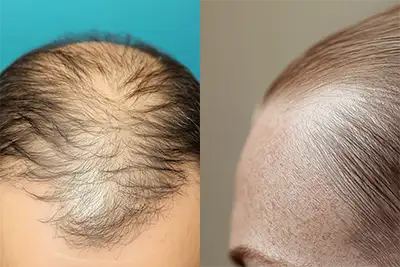
Hair Loss vs Male Pattern Baldness: What’s the Difference?
Hair loss and male pattern baldness are often used interchangeably, but they do not mean exactly the same thing. Hair loss is a general term describing excessive shedding, thinning, bald patches, or a reduction in hair density. Male pattern baldness is a specific type of hair loss that usually develops gradually because of genetic susceptibility and the effects of androgens on hair follicles.
This distinction is important because not every man who notices more hair in the shower is developing male pattern baldness. Some men experience temporary shedding after an illness, major stress, rapid weight loss, nutritional deficiency, or medication changes. Others develop hereditary hair thinning that gradually affects the temples, frontal hairline, and crown.
Understanding the cause helps determine whether hair may grow back naturally, whether an underlying health issue needs attention, or whether long-term treatment may help preserve existing hair.
This guide explains the difference between general hair loss and male pattern baldness, their causes, symptoms, diagnostic methods, treatment options, and the warning signs that should prompt a medical assessment.
What Is Hair Loss?
Hair loss is the partial or complete loss of hair from the scalp or other parts of the body. The medical term is alopecia. It can develop suddenly or gradually, affect the entire scalp, create isolated bald patches, or cause individual hair strands to become progressively thinner.
Hair naturally grows and sheds in cycles. Each follicle passes through a growth phase, a transition phase, a resting phase, and a shedding phase. Losing some hair every day is therefore a normal part of the hair-growth cycle.
The NHS estimates that people normally lose approximately 50 to 100 hairs from their scalp daily. This shedding is usually replaced by new growth, so the overall amount of hair remains relatively stable.
Hair loss becomes more noticeable when shedding increases, new growth does not adequately replace shed hair, follicles produce progressively thinner strands, or the follicles are damaged.
For example, a man may notice more hair falling out after recovering from a high fever. Another may develop several smooth bald patches because of an autoimmune condition. A third may experience gradual thinning around the temples over several years.
These are different patterns of hair loss, and they do not necessarily have the same cause or treatment.
What Is Male Pattern Baldness?
Male pattern baldness, medically known as male androgenetic alopecia, is a hereditary form of progressive hair thinning. It is the most common type of hair loss in men.
The condition develops when genetically susceptible hair follicles respond to androgens, particularly dihydrotestosterone (DHT). Over time, affected follicles become smaller and produce shorter, finer, and less pigmented hairs. This process is called follicular miniaturisation.
As miniaturisation progresses, the affected follicles produce increasingly thin hair until visible coverage is substantially reduced. Some follicles may eventually stop producing visible hair.
Male pattern baldness usually follows a recognisable distribution. It commonly begins with recession around the temples or frontal hairline, thinning at the crown, or a combination of both. The hair at the back and sides of the scalp is often more resistant to this process.
The condition can begin after puberty, although many men do not notice significant changes until adulthood. It generally progresses over years rather than causing sudden, extensive shedding.
The British Association of Dermatologists explains that male pattern hair loss is influenced by genetic and hormonal factors. Its patient guidance also notes that more than 190 genes have been identified as contributing to the condition, illustrating why inheritance is more complex than a simple rule about which parent a man takes after.
Male pattern baldness is not an infection, a sign of poor hygiene, or necessarily evidence of an abnormal testosterone level. It is primarily a genetically influenced response of certain scalp follicles to normal androgen activity.
Hair Loss vs Male Pattern Baldness: Key Differences
The simplest way to understand the difference is to recognise that male pattern baldness is one specific form of hair loss, whereas hair loss describes a much wider group of conditions.
| Comparison | General hair loss | Male pattern baldness |
| Meaning | Broad term for shedding, thinning, or bald areas | Specific hereditary form of progressive hair loss |
| Common causes | Stress, illness, medication, nutritional deficiency, autoimmune conditions, scalp disorders, and genetics | Genetic susceptibility and androgen sensitivity |
| Onset | Can be sudden or gradual | Usually gradual |
| Hair distribution | Diffuse thinning, patches, or localised loss | Commonly temples, frontal hairline, and crown |
| Hair shedding | May increase noticeably | Often gradual miniaturisation rather than dramatic shedding |
| Reversibility | Depends on the underlying cause | Usually progressive without ongoing treatment |
| Scalp appearance | May show redness, scaling, inflammation, or smooth patches depending on the cause | Often appears relatively normal |
| Treatment | Depends on the diagnosis | Commonly includes topical minoxidil and prescription finasteride when appropriate |
These are general patterns rather than diagnostic rules. A person can experience more than one type of hair loss at the same time. For example, someone with male pattern baldness may also develop temporary shedding after a serious illness.
What Causes General Hair Loss in Men?
Hair loss can develop for several reasons. Identifying the underlying trigger is essential because treating one type of hair loss will not necessarily help another.
1. Telogen Effluvium and Physical or Emotional Stress
Telogen effluvium is a type of temporary hair shedding that occurs when more hair follicles than usual enter the resting phase of the hair-growth cycle.
It may develop after a significant physical or emotional event, including:
- A high fever or serious infection.
- Major surgery or hospitalisation.
- Significant emotional stress.
- Rapid weight loss or restrictive dieting.
- A major nutritional deficiency.
- Certain medication changes.
The shedding often becomes noticeable several weeks or months after the triggering event rather than immediately.
A man recovering from a serious illness, for example, may notice more hair on his pillow, in the shower, or on his comb. The shedding can affect the entire scalp rather than following the typical temple-and-crown pattern of male pattern baldness.
In many cases, hair growth gradually improves after the underlying trigger resolves. However, recovery can take several months, and persistent shedding deserves medical assessment.
2. Nutritional Deficiencies
Hair follicles require adequate nutrition to support normal growth. Insufficient dietary intake or certain deficiencies can contribute to hair shedding.
Potential nutritional factors include:
- Iron deficiency.
- Inadequate protein intake.
- Zinc deficiency.
- Certain vitamin deficiencies.
- Severe calorie restriction.
Iron deficiency can be particularly relevant when a person has an inadequate diet, blood loss, or an underlying condition affecting iron absorption.
However, hair thinning does not automatically mean that a person has a vitamin or mineral deficiency. Taking high-dose supplements without confirming a deficiency is not a reliable hair-loss treatment. Excessive intake of certain nutrients can itself cause health problems.
A healthcare professional may recommend blood tests when the medical history or examination suggests a nutritional issue.
3. Thyroid and Other Medical Conditions
Thyroid disorders can affect the hair-growth cycle. Both an underactive and an overactive thyroid may contribute to diffuse hair thinning in some people.
Other medical conditions, including certain autoimmune diseases and chronic illnesses, may also affect hair growth.
In these situations, hair loss may occur alongside other symptoms. For example, a person with a thyroid disorder may experience fatigue, changes in weight, temperature sensitivity, or changes in heart rate.
The presence of hair loss alone cannot confirm a thyroid problem. A clinician can decide whether thyroid testing or other investigations are appropriate.
4. Alopecia Areata
Alopecia areata is an autoimmune condition in which the immune system mistakenly attacks hair follicles. It commonly causes smooth, round or oval bald patches on the scalp.
Unlike typical male pattern baldness, alopecia areata may develop relatively quickly. Some people lose hair from their beard, eyebrows, eyelashes, or other body areas.
The condition can vary considerably. Some people develop one or two small patches, while others experience extensive hair loss.
Alopecia areata is not the same as male pattern baldness, and its treatment approach is different. A dermatologist can assess the pattern and recommend appropriate management.
5. Scalp Infections and Inflammatory Conditions
Certain fungal infections and inflammatory scalp disorders can interfere with healthy hair growth.
A fungal scalp infection, for example, may cause scaling, itching, broken hairs, and areas of hair loss. Inflammation around follicles may also contribute to shedding or damage.
Some inflammatory conditions can cause scarring alopecia. In these cases, the follicles may be permanently damaged, making early diagnosis particularly important.
Persistent redness, pain, scaling, crusting, pus, or areas of shiny scar-like skin should not be dismissed as ordinary male pattern baldness.
6. Medication-Related Hair Loss
Some medications can disrupt the hair-growth cycle or damage actively growing hair follicles.
Examples include certain cancer treatments and other medicines that may cause hair shedding as a side effect.
If hair loss begins after starting a new medication, the timing is useful information for a clinician. However, medication should not be stopped without discussing the potential risks and alternatives with the prescribing professional.
What Causes Male Pattern Baldness?
Male pattern baldness develops through an interaction between genetics, androgen activity, and the sensitivity of individual hair follicles.
The Role of Genetics
Genetics strongly influences whether a man develops male pattern baldness, when it begins, and how extensive it becomes.
The condition can be inherited from either or both parents. It is therefore inaccurate to assume that a man will only inherit baldness from his mother’s side of the family.
Different family members may also experience different levels of hair loss. One man may develop a receding hairline in his twenties, while another relative may retain substantial hair density well into later adulthood.
Family history can provide useful clues, but it cannot predict an individual’s exact pattern or age of onset.
The Role of Dihydrotestosterone (DHT)
Dihydrotestosterone is an androgen produced when the enzyme 5-alpha-reductase converts testosterone into DHT.
DHT plays an important role in male development and several normal bodily functions. However, in men with genetically susceptible scalp follicles, DHT can contribute to progressive follicular miniaturisation.
The process generally involves:
- DHT interacts with androgen receptors in susceptible hair follicles.
- The affected follicles gradually become smaller.
- Hair strands become shorter and finer.
- The growth phase of affected hairs becomes shorter.
- Visible scalp coverage gradually decreases.
This explains why male pattern baldness can occur even when a man’s testosterone levels are within the normal range. The important factor is not simply how much testosterone or DHT is present, but how susceptible particular follicles are to androgen activity.
Why the Hair at the Back and Sides Often Remains
In many men with androgenetic alopecia, follicles at the back and sides of the scalp are less affected by the miniaturisation process than follicles at the temples and crown.
This difference in follicular sensitivity helps explain the characteristic horseshoe-shaped pattern seen in more advanced male pattern baldness.
It is also relevant to hair transplantation. Surgeons may use suitable follicles from the back and sides of the scalp as donor hair, although not every patient has enough stable donor hair for a successful procedure.
Common Signs of Hair Loss in Men
General hair loss does not have one specific appearance. The symptoms depend on the cause, the speed of onset, and the areas affected.
Some common signs include:
- More hair falling out during washing or brushing.
- Noticeable thinning across the scalp.
- Reduced hair density around the temples.
- A widening area of visible scalp.
- Small or clearly defined bald patches.
- Broken hairs or uneven hair lengths.
- Changes in scalp condition, including itching or scaling.
Sudden shedding across the scalp may suggest a different process from gradual recession at the temples. Similarly, patchy loss with inflammation deserves a different assessment from slowly progressive thinning.
The pattern, timing, and associated symptoms are more useful than the number of hairs a person notices on a single day.
Common Signs of Male Pattern Baldness
Male pattern baldness generally develops in a predictable distribution, although its progression varies between individuals.
Receding Hairline
One of the earliest signs is gradual recession around the temples. The frontal hairline may move backward, creating an M-shaped appearance.
Some men naturally have a mature hairline, so a slightly higher forehead does not automatically indicate male pattern baldness. Changes over time are more informative than one photograph.
Thinning at the Crown
The crown, also known as the vertex, may gradually become thinner. Some men first notice this when looking at photographs taken from above.
A small area of reduced density may expand over time if the condition progresses.
Thinning Across the Frontal Scalp
The hair behind the frontal hairline may also become finer and less dense. Rather than falling out all at once, individual strands may become progressively shorter and thinner.
Gradual Progression
Male pattern baldness usually develops over several years or decades. It may progress slowly, remain relatively stable for periods, or become more noticeable with age.
The British Association of Dermatologists describes the condition as generally slow-moving, although an earlier age of onset may be associated with faster progression.
How Common Is Male Pattern Baldness?
Male pattern baldness is common, but prevalence estimates vary according to age, population, ethnicity, and the definition used in each study.
The American Academy of Dermatology reports that more than half of white men have visible signs of male pattern hair loss by age 50. This figure should not be interpreted as a universal estimate for every ethnic or geographic population.
A clinical review published in the NCBI Bookshelf reports that male androgenetic alopecia affects approximately 30% to 50% of men by age 50.
These estimates demonstrate that male pattern baldness becomes increasingly common with age. They do not mean that every man will develop severe baldness or follow the same progression.
For readers in Pakistan and other South Asian countries, it is particularly important not to assume that figures reported for white populations apply directly to local populations. Reliable prevalence estimates should be interpreted in the context of the population studied.
How Do Doctors Diagnose Hair Loss and Male Pattern Baldness?
A correct diagnosis is the foundation of effective treatment. Since different conditions can produce similar symptoms, a dermatologist generally considers the history, distribution, scalp appearance, and possible underlying triggers.
Medical and Family History
A dermatologist may ask:
- When did the hair loss begin?
- Did it develop suddenly or gradually?
- Is hair shedding occurring across the entire scalp?
- Are the temples or crown becoming thinner?
- Has there been a recent illness, surgery, or major stress?
- Have you changed medication or diet?
- Do close family members have a history of pattern baldness?
- Is there itching, pain, scaling, or redness?
These questions help distinguish hereditary hair thinning from temporary shedding and other scalp conditions.
Scalp Examination
The dermatologist examines the scalp to identify the distribution and characteristics of hair loss.
For male pattern baldness, the clinician may look for a receding frontal hairline, crown thinning, and differences in hair thickness between affected and unaffected areas.
For other conditions, the examination may reveal broken hairs, smooth bald patches, inflammation, scaling, or signs of scarring.
Hair Pull Test and Dermoscopy
A hair pull test involves gently pulling a small group of hairs to assess whether an unusually high number comes away.
Dermoscopy allows the clinician to examine the scalp and hair follicles at higher magnification. It can help identify variations in hair shaft diameter and other features associated with androgenetic alopecia.
These assessments can provide useful clues, but no single test should be interpreted without considering the overall clinical picture.
Blood Tests and Scalp Biopsy
Blood tests are not automatically required for every man with hair thinning.
When the medical history suggests a possible underlying condition, a clinician may request tests such as a complete blood count, iron studies, or thyroid function tests. Other tests may be considered according to the symptoms and examination.
A scalp biopsy may occasionally be recommended when the diagnosis remains uncertain or a scarring condition is suspected.
The American Academy of Dermatology explains that diagnosis may involve a medical history, scalp and nail examination, hair assessment, and selected blood tests or biopsy when clinically indicated.
Treatment Options for General Hair Loss
Treatment depends on the underlying cause. There is no single medicine or hair product that treats every form of alopecia.
Treating the Underlying Cause
If hair shedding is associated with a nutritional deficiency, thyroid disorder, infection, or another medical condition, treatment should address that specific problem.
For example, correcting a confirmed iron deficiency may help when it is contributing to hair loss. Treating an underlying infection may also allow normal hair growth to recover, depending on whether permanent follicle damage has occurred.
Managing Telogen Effluvium
When temporary shedding follows illness, surgery, or another significant trigger, treatment often involves identifying and addressing the trigger.
Hair shedding may continue for a period even after the underlying issue has improved because hair follicles do not return to the growth phase immediately.
A clinician can help determine whether the pattern is consistent with telogen effluvium or whether another condition is also present.
Treating Alopecia Areata
Treatment for alopecia areata depends on the extent of hair loss, the affected areas, and the patient’s circumstances.
Dermatologists may recommend corticosteroid injections or topical treatments for selected cases. More extensive disease may require specialist treatment, including certain medicines that affect immune activity.
These treatments are not interchangeable with standard male pattern baldness treatments.
Treatment Options for Male Pattern Baldness
Male pattern baldness is usually a long-term condition. Treatment aims to slow progression, preserve existing hair, and, in some cases, improve hair density.
Two established medication options are topical minoxidil and oral finasteride. Their suitability depends on individual health, treatment goals, potential side effects, and local regulatory guidance.
1. Minoxidil
Topical minoxidil is commonly used to treat male pattern hair loss. It is applied directly to the scalp according to the product instructions and the advice of a healthcare professional.
Research and clinical guidance indicate that minoxidil can help reduce hair loss and stimulate growth in some men. It is generally more useful when treatment begins before extensive follicular miniaturisation has occurred.
Results are not immediate. The American Academy of Dermatology explains that some men may need approximately 6 to 12 months to see visible improvement.
Possible side effects include scalp irritation, itching, dryness, and unwanted hair growth if the product spreads to other areas.
Some people notice increased shedding during the early weeks of treatment. This can be temporary, but severe or persistent reactions should be discussed with a clinician.
The benefits generally require continued use. Stopping treatment may lead to the gradual loss of the hair maintained or gained through minoxidil.
2. Finasteride
Finasteride is an oral prescription medicine used to treat male pattern hair loss in appropriate patients.
It works by inhibiting the enzyme 5-alpha-reductase, reducing the conversion of testosterone into DHT. This can help slow the follicular miniaturisation associated with androgenetic alopecia.
Some men experience improved hair density, while others mainly benefit from slowing further loss.
Finasteride is not suitable for everyone. Potential adverse effects include sexual side effects, such as reduced libido or erectile difficulties. Mood-related symptoms and other concerns should also be discussed with the prescribing clinician.
A person considering finasteride should review the benefits, risks, medical history, and product information with a qualified healthcare professional rather than starting it independently.
As with minoxidil, continued treatment is generally needed to maintain its benefits.
3. Hair Transplant Surgery
Hair transplantation may be an option for selected men with established male pattern baldness.
During the procedure, a surgeon moves hair follicles from a suitable donor area, commonly the back or sides of the scalp, into areas affected by thinning.
Two commonly discussed techniques are:
- Follicular Unit Transplantation (FUT), in which a strip of scalp is removed and divided into follicular units.
- Follicular Unit Extraction (FUE), in which individual follicular units are removed from the donor area.
The appropriate technique depends on donor hair availability, scalp characteristics, the extent of hair loss, and the surgeon’s assessment.
A hair transplant does not stop the progression of untreated male pattern baldness in the surrounding native hair. A long-term plan may therefore be needed to preserve existing hair.
Surgery also carries risks, including scarring, infection, poor graft growth, and an unnatural appearance if the procedure is poorly planned. Consultation with a qualified, experienced hair-restoration surgeon is essential.
4. Platelet-Rich Plasma (PRP)
Platelet-rich plasma treatment involves taking a blood sample, processing it to concentrate platelets, and injecting the resulting preparation into selected scalp areas.
PRP is offered by some clinics for hair thinning. However, treatment protocols and study results vary, and the evidence is less established than for standard medication options.
Patients should ask what evidence supports the proposed treatment, how many sessions are expected, what the total cost will be, and what outcomes are realistic.
PRP should not be advertised as a guaranteed cure for male pattern baldness.
5. Low-Level Laser and Light Devices
Some laser caps, combs, and other light-based devices are marketed for hereditary hair loss.
There is research suggesting that selected devices may improve hair density in some people, but results vary. The evidence base is more limited than that for established medication treatments, and devices differ in quality and regulatory status.
A dermatologist can help determine whether a device is worth considering as part of an overall treatment plan.
Can Male Pattern Baldness Be Reversed?
Male pattern baldness cannot currently be permanently cured, but treatment can help slow its progression and improve hair growth in some men.
The likelihood of improvement depends on several factors, including:
- How advanced the hair loss is.
- How long the affected follicles have been miniaturising.
- The individual’s response to treatment.
- Consistency of treatment.
- Whether another condition is contributing to the hair loss.
Hair follicles that still produce thin, miniaturised hairs may respond better than areas where visible hair production has been absent for a long time.
This is one reason why early assessment can be valuable. It allows a dermatologist to establish a baseline and discuss realistic options before extensive hair loss occurs.
It is equally important to understand that stopping treatment may result in the gradual loss of its benefits. Medication should be viewed as ongoing management rather than a permanent one-time solution.
When Should Men See a Dermatologist?
Not every loose hair is a medical concern. However, certain changes deserve professional assessment rather than repeated experimentation with shampoos, oils, or supplements.
Arrange a medical assessment if you notice:
- Sudden or unusually heavy hair shedding.
- Rapidly developing bald patches.
- Hair loss affecting the eyebrows, beard, or eyelashes.
- Scalp pain, persistent itching, redness, or scaling.
- Broken hairs or signs of infection.
- Shiny or scar-like areas where hair has disappeared.
- Hair loss accompanied by unexplained fatigue, weight changes, or other health symptoms.
- Progressive thinning that is affecting your confidence or wellbeing.
Prompt assessment is especially important when inflammation or scarring is suspected, because some forms of hair loss can cause permanent follicle damage.
The NHS recommends seeking medical advice about hair loss and advises people to understand the cause before turning to commercial hair clinics.
Common Myths About Hair Loss and Male Pattern Baldness
Misinformation can lead men to spend money on treatments that do not address the actual cause of their hair loss.
Myth 1: All Hair Loss in Men Is Hereditary
This is incorrect. Genetics is a major factor in male pattern baldness, but men can also experience temporary shedding, autoimmune hair loss, nutritional deficiencies, medication-related shedding, and scalp disorders.
Myth 2: Male Pattern Baldness Comes Only From the Mother’s Side
Male pattern baldness involves multiple genes, and inheritance can come from either or both parents. Looking at only one side of the family does not provide a complete picture.
Myth 3: Frequent Shampooing Causes Male Pattern Baldness
Ordinary shampooing does not cause genetically driven follicular miniaturisation. Washing may make already-loose hairs more noticeable, but that does not mean shampoo has caused the underlying condition.
Harsh products or excessive heat and chemical treatments can damage hair shafts, leading to breakage. Hair breakage, however, is different from male pattern baldness.
Myth 4: Oils Can Permanently Reverse Baldness
Hair oils may help condition the hair and reduce dryness, but there is no reliable clinical basis for claiming that ordinary oils permanently reverse androgenetic alopecia.
A product that makes hair look smoother or fuller is not necessarily changing the biological process affecting the follicles.
Myth 5: More Testosterone Always Means More Hair Loss
Male pattern baldness is related to androgen activity and genetic sensitivity, not simply a high testosterone result. Men with normal testosterone levels can develop substantial hereditary hair loss.
Myth 6: A Hair Transplant Stops All Future Hair Loss
A transplant moves follicles into areas of thinning. It does not prevent untreated native hair from continuing to miniaturise. A long-term treatment strategy may still be necessary.
How to Support Healthy Hair Growth
Healthy habits cannot guarantee prevention of hereditary male pattern baldness, but they can support general hair and scalp health.
A balanced diet should provide adequate protein, iron, zinc, and other essential nutrients. Men following restrictive diets should ensure that their nutritional intake is appropriate.
Avoid crash dieting and rapid weight-loss programmes, as significant nutritional or physical stress can contribute to temporary shedding.
Use hair products and styling techniques that minimise breakage. Excessive heat, harsh chemical treatments, and tight hairstyles can damage hair, even though they do not cause the same follicular changes as androgenetic alopecia.
Manage health conditions with professional guidance, and discuss medication-related shedding with the prescribing clinician.
Finally, avoid relying on before-and-after photographs or dramatic claims from commercial hair clinics as proof that a treatment will work. A proper diagnosis and realistic treatment plan are more valuable than a product promising rapid regrowth.
Final Thoughts: Understanding the Difference Helps You Choose the Right Treatment
Hair loss is a broad medical term that includes several conditions, while male pattern baldness is a specific hereditary form of progressive hair thinning associated with DHT-sensitive follicles.
The distinction is important because temporary shedding caused by illness, stress, nutritional problems, or medication may improve when the underlying cause is addressed. Male pattern baldness, on the other hand, usually requires long-term management if a man wants to slow its progression or maintain treatment-related improvement.
A receding hairline and thinning crown may suggest androgenetic alopecia, but sudden shedding, bald patches, scalp inflammation, or loss of eyebrow and beard hair may point to another condition.
Rather than assuming that every change in hair density is hereditary, men should seek an appropriate assessment when hair loss is persistent, sudden, unusual, or concerning. A dermatologist can identify the likely cause and explain which treatments are supported by evidence.
The most useful first step is not buying another hair-growth product. It is finding out why the hair is thinning.
Frequently Asked Questions (FAQs)
1. What is the main difference between hair loss and male pattern baldness?
Hair loss is a general term for shedding, thinning, or bald patches. Male pattern baldness is a specific hereditary form of hair loss that usually affects the temples, frontal hairline, and crown. It is associated with genetic susceptibility and the effects of DHT on scalp follicles.
2. Is male pattern baldness the most common type of hair loss in men?
Yes. Male pattern baldness, also called androgenetic alopecia, is the most common form of hair loss in men. Its frequency generally increases with age, although it can begin in younger adults.
3. Can stress cause male pattern baldness?
Stress can contribute to temporary hair shedding, particularly through a condition called telogen effluvium. This is different from hereditary male pattern baldness. However, both conditions can occur in the same person, so persistent thinning should be assessed.
4. How can I tell whether my hair loss is hereditary?
A gradually receding hairline, thinning at the crown, and a family history of similar hair loss may suggest male pattern baldness. However, these signs cannot confirm the diagnosis on their own. A dermatologist can examine the scalp and assess other possible causes.
5. Does male pattern baldness start at a particular age?
There is no single starting age. It can begin after puberty and sometimes becomes noticeable in the late teens or twenties. Many men develop more visible thinning later in adulthood.
6. Can hair grow back after general hair loss?
It depends on the cause. Hair may regrow after temporary shedding caused by illness, stress, or a correctable deficiency. Regrowth is less predictable when follicles have been permanently damaged by scarring conditions. Treatment outcomes also vary between types of alopecia.
7. Is male pattern baldness caused by high DHT levels?
Not necessarily. DHT contributes to male pattern baldness by affecting genetically susceptible hair follicles. A man can develop the condition even when his testosterone levels are within the normal range. Follicular sensitivity is an important part of the process.
8. Does minoxidil work for male pattern baldness?
Topical minoxidil can reduce hair loss and stimulate some regrowth in certain men. Results may take 6 to 12 months, and not everyone responds. Continued use is generally required to maintain the benefits.
9. Does finasteride permanently stop hair loss?
No. Finasteride can reduce DHT production and slow male pattern hair loss in suitable patients, but it is not a permanent cure. Its benefits generally require continued treatment, and potential adverse effects should be discussed with a healthcare professional.
10. Can nutritional deficiencies cause hair loss in men?
Yes. Certain deficiencies, including iron deficiency and inadequate protein intake, can contribute to hair shedding. However, not all hair loss is caused by poor nutrition. Testing and medical assessment can help determine whether a deficiency is present.
11. Can a hair transplant cure male pattern baldness?
A hair transplant can move suitable follicles into areas affected by baldness and improve appearance. It does not stop the progression of androgenetic alopecia in untreated native hair. Some patients may need ongoing medical treatment to maintain their results.
12. When should I worry about hair loss?
Seek medical advice if hair loss is sudden, unusually heavy, patchy, painful, or accompanied by scalp redness, scaling, or scarring. Hair loss affecting the eyebrows or beard, or occurring with other unexplained symptoms, also deserves assessment.