
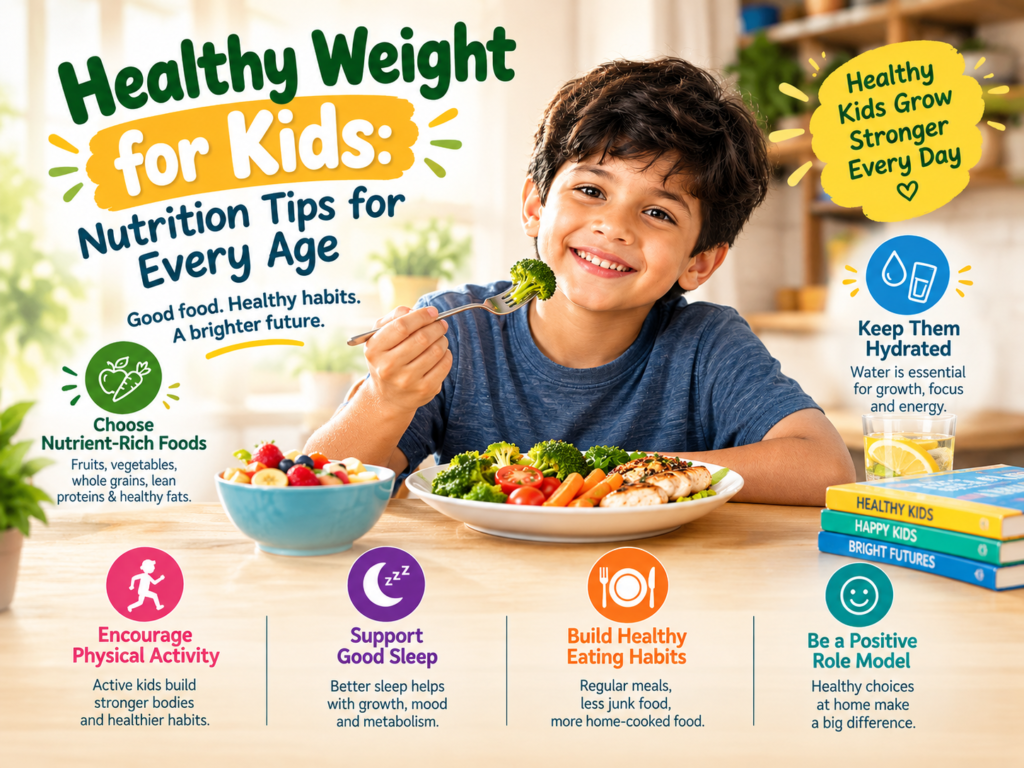
Healthy Weight for Kids: Nutrition Tips for Every Age
Healthy weight in childhood is not about making a child look a certain way or putting them on a restrictive diet. Children are constantly growing, and their nutritional needs change substantially from infancy through adolescence. A healthy approach focuses on adequate nutrition, normal growth, physical activity, sleep, emotional well-being, and regular monitoring by a qualified healthcare professional.
This distinction matters because a child can be gaining weight appropriately while looking “thin,” or gaining weight too quickly even when their diet appears reasonably healthy. Growth must therefore be evaluated in context rather than by a single number on the scale.
According to the World Health Organization (WHO), an estimated 36 million children under 5 were living with overweight in 2024, alongside approximately 150 million who were stunted and 43 million who were wasted. These figures illustrate an important reality: childhood nutrition problems include both inadequate nutrition and excess weight.
In the United States, the latest CDC National Health and Nutrition Examination Survey data for August 2021–August 2023 found that 21.1% of children and adolescents ages 2–19 had obesity, while another 15.1% were classified as overweight.
The goal, therefore, should not be simply “less weight.” The goal is healthy growth.
What Does a Healthy Weight Mean for a Child?
There is no single healthy weight that applies to every child of the same age.
Two 8-year-olds can have very different healthy weights because height, sex, genetics, puberty, muscle development, body composition, and growth patterns all influence weight. This is why adult BMI cutoffs should not be applied directly to children.
For children and teenagers ages 2–19, healthcare professionals commonly use BMI-for-age rather than an adult BMI number. CDC growth charts interpret BMI according to age and sex, producing a percentile that can be followed over time.
For example, under the CDC classification system for children ages 2–19:
| BMI-for-age | Classification |
| Below 5th percentile | Underweight |
| 5th to below 85th percentile | Healthy weight |
| 85th to below 95th percentile | Overweight |
| 95th percentile or higher | Obesity |
These categories are screening and assessment tools, not a diagnosis by themselves. CDC emphasizes that growth charts should not be used as the sole diagnostic instrument; healthcare professionals consider growth patterns, medical history, physical examination, health behaviors, and other factors.
For children under 2, the assessment is different. CDC recommends WHO growth standards for children from birth through 2 years, with measures such as weight-for-age, length-for-age, and weight-for-length. BMI-for-age is not recommended as the primary growth measure for children younger than 2 years.
This is one reason parents should avoid searching for a fixed “ideal weight” for a baby or toddler and comparing that number with another child.
Why Growth Trends Matter More Than One Measurement
A child’s growth should be considered over time.
A pediatrician may look at whether height and weight are progressing along an expected pattern, whether weight is increasing disproportionately to height, whether growth has slowed, and whether there are medical, nutritional, developmental, or social factors affecting eating.
A single measurement can be misleading. A child may temporarily gain weight before a height-related growth spurt, while another may appear relatively heavier or lighter during a particular stage of development.
The important question is not simply:
“Does my child weigh enough?”
It is:
“Is my child growing appropriately for their age, height, developmental stage, and individual health circumstances?”
That is a much more useful question for parents and healthcare providers.
Healthy Weight for Kids Starts With Nutrition, Not Calorie Restriction
Children need energy to grow.
Their bodies require protein for muscles and tissues, carbohydrates for energy, fats for brain and cellular development, calcium and vitamin D for bones, iron for blood and neurological development, and a wide range of vitamins and minerals for normal body functions.
For this reason, aggressive calorie restriction is generally not an appropriate strategy for children unless it is part of a medically supervised plan.
Instead, families can create an eating environment where nutritious foods are readily available and children learn to recognize hunger and fullness cues.
The American Academy of Pediatrics emphasizes healthy eating patterns and regular meal and snack routines rather than focusing exclusively on body weight. AAP guidance also highlights the importance of allowing children to respond to hunger and fullness cues.
A practical family eating pattern can include:
- Fruits and vegetables
- Whole grains and other minimally processed grains
- Beans, lentils, eggs, fish, poultry, meat, nuts and seeds where age-appropriate
- Milk, yogurt, cheese or suitable alternatives
- Healthy sources of unsaturated fats
- Water as the primary everyday beverage
The exact combination should reflect the child’s age, cultural food practices, allergies, medical conditions, dietary preferences, and access to food.
Nutrition Tips for Babies: Birth to 6 Months
For healthy full-term infants, nutrition during the first six months is fundamentally different from nutrition for older children.
WHO and UNICEF recommend exclusive breastfeeding for the first six months when breastfeeding is possible and appropriate, followed by complementary foods while breastfeeding continues to 2 years or beyond.
For families using infant formula, commercially prepared infant formula is an established alternative when breastfeeding is not used or is not possible. Parents should follow appropriate preparation and feeding guidance from their healthcare provider and the product instructions.
During this stage, parents should not attempt to place an infant on a “weight-loss diet” or deliberately restrict feeding because the baby appears chubby.
Infant growth should instead be monitored using appropriate growth standards.
For babies younger than 2, WHO growth standards include weight-for-age, length-for-age, and weight-for-length measurements. These provide a more developmentally appropriate way to assess growth than simply comparing body weight with an age-based number.
What Parents Should Watch For
Parents should discuss feeding or growth concerns with a pediatrician if a baby:
- Is not gaining weight as expected
- Is losing weight
- Has persistent feeding difficulties
- Frequently vomits or has significant feeding problems
- Has difficulty swallowing
- Seems unusually sleepy or weak during feeds
- Has a significant change in growth pattern
Internal linking opportunity: If your website has an infant nutrition or newborn-care article, naturally link the phrase “infant nutrition and feeding guide” to that educational resource.
Nutrition Tips for Babies and Toddlers: 6–23 Months
Around 6 months, breast milk or formula alone is no longer sufficient to meet all nutritional needs, and complementary foods should be introduced.
WHO recommends starting complementary foods at about 6 months and gradually increasing food variety, texture, quantity, and frequency as the child develops.
WHO’s current guidance recommends approximately:
- 6–8 months: complementary foods 2–3 times per day
- 9–23 months: complementary foods 3–4 times per day
- From 12–24 months: 1–2 nutritious snacks can also be offered when appropriate
These are general recommendations rather than rigid rules. Appetite and developmental readiness vary between children.
Focus on Food Variety
This is a particularly important period for developing eating patterns.
Rather than concentrating on whether a toddler eats a large amount at each meal, parents can focus on offering nutrient-dense foods from different food groups.
Examples include:
Breakfast: oatmeal with mashed banana and yogurt
Lunch: soft lentils with rice and cooked vegetables
Snack: soft fruit with plain yogurt
Dinner: finely chopped chicken or fish with vegetables and a soft grain or potato
For children who do not eat animal products, parents can use appropriately planned alternatives such as beans, lentils, tofu, fortified foods, and other suitable sources of nutrients.
Responsive Feeding Matters
WHO recommends responsive feeding, which means recognizing and responding to a child’s hunger and fullness signals rather than forcing a child to finish a specific amount.
Parents can offer nutritious foods and allow the child to decide whether and how much to eat.
That does not mean allowing unlimited access to sweets or sugary drinks. It means creating predictable meals and snacks while respecting appetite.
This approach can help children develop a healthier relationship with food and reduce unnecessary battles at mealtimes.
Healthy Weight Nutrition for Preschoolers: Ages 2–5
Preschool years are a time when children become more independent with food.
They may suddenly reject foods they previously liked, request the same meal repeatedly, or prefer snacks over full meals. This is common, but the food environment still matters.
Instead of preparing a separate “diet meal,” make the family’s everyday meals healthier.
A balanced preschool meal might include:
- A source of protein such as eggs, beans, lentils, chicken, fish or yogurt
- A vegetable or fruit
- A whole grain or other carbohydrate-rich food
- A suitable source of healthy fat
- Water or an appropriate milk serving
Children do not need adult-sized portions.
Start with modest portions and allow more food if the child remains hungry. This reduces pressure to clean the plate and allows appetite to guide intake.
Be Careful With Drinks
Liquid calories can add up quickly, particularly when children regularly consume soda, sweetened juices, flavored drinks, sports drinks, or other sugar-sweetened beverages.
CDC recommends encouraging water instead of sugary drinks and emphasizes healthy family eating patterns that include vegetables, fruits, whole grains, protein foods, and appropriate dairy choices.
For everyday hydration, water is usually the simplest choice.
Parents should also be cautious about treating fruit juice as equivalent to whole fruit. Whole fruit provides fiber and requires chewing, while juice can be consumed much more quickly.
Internal linking opportunity: Link “healthy drinks for children” to your existing hydration, pediatric nutrition, or child wellness service page if available.
Healthy Weight Nutrition for School-Age Children: Ages 6–12
School-age children have increasing independence.
They may eat breakfast and lunch away from home, purchase snacks, attend birthday parties, participate in sports, and spend more time using screens.
This means parents cannot control every meal, and they do not need to.
The objective is to establish a reliable foundation at home.
A useful daily pattern is:
Breakfast → nutritious school meal → planned snack if needed → family dinner → water throughout the day
A child who regularly skips breakfast and then becomes extremely hungry later may be more likely to choose highly processed snack foods. A consistent eating routine can make healthy choices easier.
Build Meals Around Nutrient Density
Instead of obsessing over calorie counts, ask:
Does this meal provide protein?
Does it contain a fruit or vegetable?
Does it provide fiber-rich carbohydrates?
Does it contain an appropriate source of calcium?
Is there a healthy fat source?
Is water available?
This shifts the conversation from “How many calories did my child eat?” to “What nutrients did my child’s diet provide?”
For most families, this is a more practical and sustainable approach.
Make Healthy Food Convenient
Children often eat what is readily available.
Keep options such as fruit, yogurt, boiled eggs, whole-grain foods, vegetables with hummus, beans, nuts or nut butters where age-appropriate, and other nutritious foods accessible.
This does not require eliminating every less nutritious food from the home.
A healthier strategy is to make nutritious foods the default while teaching children that treats can fit into an overall balanced eating pattern.
Nutrition and Healthy Weight for Teenagers: Ages 13–18
Adolescence introduces additional complexity.
Puberty causes major changes in height, muscle mass, body composition, appetite, hormones, and energy needs. Teenagers may also become more sensitive about body image.
A teenager involved in sports may require substantially more energy than a sedentary teenager. A teenager going through a rapid growth spurt may also experience increased hunger.
This is why parents should be particularly cautious about unsupervised calorie restriction.
Watch for Signs of Unhealthy Dieting
Warning signs can include:
- Skipping meals regularly
- Extreme restriction of food groups
- Persistent fear of gaining weight
- Compulsive exercise
- Frequent weighing or body checking
- Intense guilt after eating
- Rapid unexplained weight loss
- Avoiding eating with family or friends
- Vomiting or misuse of laxatives or other products to control weight
Eating disorders can affect children and adolescents and may involve restrictive eating, distorted body image, intense fear of weight gain, or compensatory behaviors.
If these behaviors appear, the priority is not simply changing the teenager’s weight. The child should receive appropriate medical and mental-health evaluation.
Internal linking opportunity: If your website offers pediatric counseling, adolescent health, eating-disorder support, or mental-health services, this is a strong contextual place to link to that service page.
How Much Physical Activity Do Kids Need?
Nutrition is only one part of healthy growth.
Children also need regular movement, and the goal should be enjoyment and physical development rather than exercising to “burn calories.”
CDC recommends that children ages 3–5 remain physically active throughout the day.
For children and adolescents ages 6–17, the recommendation is at least 60 minutes of moderate-to-vigorous physical activity each day. The activity should include aerobic movement, with muscle- and bone-strengthening activities incorporated at least three days per week.
That 60 minutes does not have to happen in a single workout.
A child might get there through:
20 minutes of walking or cycling
20 minutes of playground or sports activity
20 minutes of active play after school
The best activity is usually one the child enjoys enough to continue.
Running, swimming, football, basketball, cycling, dancing, jumping rope, martial arts, hiking, playground games, and active family walks can all contribute.
Sleep Is Part of Healthy Weight Management
Sleep is often overlooked when families discuss children’s weight.
Yet sleep is part of a child’s overall health routine.
CDC recommendations are:
| Age | Recommended sleep |
| 4–12 months | 12–16 hours, including naps |
| 1–2 years | 11–14 hours, including naps |
| 3–5 years | 10–13 hours, including naps |
| 6–12 years | 9–12 hours |
| 13–17 years | 8–10 hours |
Insufficient sleep is associated with several health concerns, and CDC notes that inadequate sleep in children and teenagers is associated with obesity.
A predictable bedtime routine, consistent wake time, and reducing stimulating screen use near bedtime can make healthy sleep easier.
Internal linking opportunity: Use anchor text such as “sleep tips for children by age” to link to an existing pediatric sleep blog or sleep-related service.
Healthy Weight Is Not Just About Food
Genetics, sleep, physical activity, family routines, medications, medical conditions, stress, food availability, socioeconomic factors, and the surrounding environment can all influence childhood weight.
CDC describes childhood obesity as a complex condition with multiple contributing factors, including genes, eating patterns, physical activity, sleep, healthcare access, and environmental conditions.
This is important because parents can sometimes feel that a child’s weight is entirely their fault.
It is not.
A supportive family environment can make healthy choices easier, but body weight is influenced by factors beyond any single meal or parenting decision.
Avoid Putting Children on Crash Diets
One of the most important nutrition tips for parents is also one of the easiest to overlook: children generally should not be placed on restrictive weight-loss diets without professional guidance.
A growing child needs sufficient energy and nutrients for:
- Brain development
- Bone growth
- Muscle development
- Puberty
- Hormonal function
- Immune function
- Physical activity
- Learning and concentration
Restrictive eating can unintentionally cause nutrient deficiencies or contribute to an unhealthy relationship with food.
If a healthcare professional determines that a child is overweight or obese, treatment does not necessarily mean simply telling the child to “eat less.”
The AAP clinical practice guideline emphasizes evidence-based, family-centered treatment, and CDC describes intensive health behavior and lifestyle treatment as an appropriate evidence-based approach for eligible children and families.
CDC-recognized Family Healthy Weight Programs are designed for children ages 2–18 and their caregivers and involve at least 26 hours of contact over a period of 2–12 months.
How Parents Can Talk About Weight Without Creating Shame
Language matters.
A child who repeatedly hears “you’re too fat” may begin to associate food, exercise, and their body with shame.
Instead of making body size the center of family conversations, focus on health behaviors.
For example:
Instead of: “You need to lose weight.”
Try: “Let’s find foods that help your body grow strong.”
Instead of: “That food will make you fat.”
Try: “Let’s have this food sometimes and include some fruit or vegetables with it.”
Instead of: “You need to exercise.”
Try: “Let’s go outside and find something fun to do.”
Weight stigma can cause harm. CDC notes that stigma is associated with binge eating, social isolation, avoiding healthcare, reduced physical activity, and other unhealthy behaviors.
The aim should be to help children develop healthy behaviors without teaching them that their body determines their worth.
A Practical Healthy Eating Plate for Kids
Families do not need complicated meal plans.
A simple meal-building framework can be:
1. Add a protein source
Examples include eggs, fish, chicken, meat, beans, lentils, tofu, yogurt, cheese, nuts, or seeds when developmentally appropriate.
2. Add a fruit or vegetable
Use fresh, frozen, or appropriately prepared options.
Frozen and canned produce can also be nutritious and may be more affordable. CDC specifically notes that frozen and canned fruits and vegetables can be good choices when selected appropriately.
3. Add an energy-rich carbohydrate
Whole grains, potatoes, rice, oats, corn, and other grains can provide energy needed for growth and activity.
4. Include an appropriate fat source
Nuts, seeds, nut butters, avocado, olive oil, and other sources of unsaturated fat can fit into a balanced diet.
5. Offer water
Make water easy to access throughout the day.
This framework is flexible enough to work across different cultures and cuisines.
A healthy children’s diet does not have to look like a Western “diet food” menu.
Rice and lentils, chapati with vegetables and yogurt, beans with corn, fish with potatoes, egg sandwiches, vegetable curries, soups, oats, fruit, dairy products, and many other traditional foods can be part of a healthy eating pattern when portions and preparation are appropriate.
What If Your Child Is Underweight?
Healthy weight conversations should include children who are not gaining enough weight.
Signs that deserve discussion with a pediatrician can include:
- Falling across growth percentiles
- Poor weight gain
- Persistent low appetite
- Difficulty chewing or swallowing
- Frequent vomiting or diarrhea
- Food allergies or intolerances
- Significant feeding difficulties
- Chronic illness
- Developmental concerns
- Unexplained weight loss
The American Academy of Pediatrics notes that “faltering weight” can describe a situation in which a child is not gaining enough weight, is losing weight, or has a concerning growth pattern. Assessment typically includes growth history, medical history, and physical examination.
Parents should not simply increase junk food or sugary drinks to make a child gain weight.
Instead, the goal is nutrient-dense energy.
Depending on age and medical needs, a clinician or pediatric dietitian may recommend foods such as nut or seed butter, full-fat dairy when appropriate, eggs, avocado, beans, lentils, healthy oils, nutrient-dense grains, or other energy-rich foods.
The right strategy depends on the underlying cause.
When Should Parents Talk to a Pediatrician About Weight?
Parents should consider discussing growth with a healthcare professional when:
- A child’s weight changes rapidly
- A child crosses growth percentiles unexpectedly
- There is unexplained weight loss
- A child is not gaining weight as expected
- Eating becomes highly restrictive
- A child has persistent fatigue or weakness
- There are signs of an eating disorder
- A child has symptoms of diabetes or another chronic condition
- The family is concerned about overweight or obesity
- Food, exercise, or body image is causing significant distress
A pediatrician can assess the child’s growth trajectory rather than relying on an online “ideal weight” chart.
For children with overweight or obesity, evaluation may also consider metabolic health, mental and behavioral health, medical history, physical examination, and appropriate laboratory testing.
A Simple Healthy Weight Routine for the Whole Family
A practical family routine can look like this:
Morning
Start with breakfast containing a protein source plus a fiber-rich carbohydrate and/or fruit.
School or daycare
Provide or encourage a balanced meal with protein, whole grains or other filling carbohydrates, and produce where possible.
Afternoon
Offer a planned snack if the child is hungry rather than allowing unrestricted grazing.
Evening
Serve a family dinner with vegetables or fruit, protein, and a suitable carbohydrate.
Activity
Build movement into everyday life rather than treating exercise as punishment for eating.
Evening routine
Reduce stimulating screen activities before bedtime and maintain an age-appropriate sleep schedule.
Family approach
Parents should model the same healthy habits they expect from children.
Children learn much more from what families routinely do than from occasional lectures about nutrition.
Healthy Weight for Kids: The Most Important Takeaways
Healthy weight in childhood is about growth, not dieting.
The most useful principles are:
- Monitor growth over time rather than relying on a single weight measurement.
- Use age-appropriate growth charts and professional assessment.
- Offer varied, nutrient-dense foods.
- Encourage children to recognize hunger and fullness.
- Make water an everyday beverage.
- Keep sugary drinks and highly processed foods from becoming daily staples.
- Avoid restrictive diets unless medically supervised.
- Encourage enjoyable physical activity.
- Protect adequate sleep.
- Avoid weight-based teasing, shame, and criticism.
- Seek professional guidance when growth changes unexpectedly.
- Treat the whole family as the environment for healthy habits.
Most importantly, healthy weight is not a race toward a particular number.
The aim is to help children grow, learn, move, sleep, eat, and develop in a way that supports lifelong health.
FAQs About Healthy Weight for Kids
What is a healthy weight for a child?
There is no single healthy weight for every child of the same age. Healthy weight depends on age, height, sex, growth pattern, development, and other health factors. For children ages 2–19, healthcare professionals commonly use BMI-for-age percentiles together with the child’s overall medical and growth history.
How do I know if my child is at a healthy weight?
A pediatrician can measure your child’s height and weight and plot the results on an appropriate growth chart. For children under 2, WHO growth standards are used in many clinical settings; for children 2 and older, CDC growth charts are commonly used in the United States.
Should I put my child on a diet if they are overweight?
Do not start a restrictive weight-loss diet without professional guidance. Children need adequate nutrition for growth and development. If you are concerned about your child’s weight, speak with a pediatrician who can determine whether nutritional changes, family-based lifestyle treatment, or further assessment is appropriate.
What foods help children maintain a healthy weight?
A balanced eating pattern can include vegetables, fruits, whole grains, protein foods such as beans, lentils, eggs, fish and poultry, suitable dairy products, and healthy fats. Water is generally preferable to sugar-sweetened drinks.
How much physical activity does a child need?
Children ages 3–5 should be active throughout the day. Children and adolescents ages 6–17 should get at least 60 minutes of moderate-to-vigorous physical activity each day, including aerobic activity and muscle- and bone-strengthening activities during the week.
How many hours should children sleep?
Sleep recommendations vary by age. Infants 4–12 months generally need 12–16 hours including naps; children 1–2 years need 11–14 hours; preschoolers 3–5 need 10–13 hours; children 6–12 need 9–12 hours; and teenagers 13–17 need 8–10 hours per day.
Can a child be healthy even if they are not at the “average” weight?
Yes. Children naturally vary in body size and growth patterns. Being above or below an average weight does not automatically mean a child is unhealthy. Healthcare professionals evaluate growth using age- and sex-specific standards and the child’s broader health picture.
What should I do if my child is not gaining enough weight?
Speak with a pediatrician if your child is consistently failing to gain weight, losing weight, has feeding difficulties, or shows a significant change in their growth pattern. The underlying cause needs to be assessed before choosing a nutrition strategy.
Are sugary drinks bad for children’s healthy weight?
Regular consumption of sugar-sweetened beverages can make it easier for children to consume excess added sugars and calories. CDC recommends encouraging water instead of sugary drinks as part of healthy family habits.
Should parents talk to children about their weight?
Parents can discuss health, nutrition, movement, and well-being, but weight-based criticism and shame should be avoided. Weight stigma can contribute to harmful behaviors such as binge eating, social isolation, avoidance of healthcare, and reduced physical activity.
When should a child see a doctor about weight?
Consider professional evaluation when there is rapid or unexplained weight change, poor weight gain, significant growth-curve changes, restrictive eating, eating-disorder symptoms, or concerns about being overweight or obese. A pediatrician can assess the child’s individual growth pattern and determine whether additional evaluation is needed.